.svg)



Demystifying AI in Procurement
The Problem: Feedback Uncertainty
A tender without structured feedback is a negotiation where one party is blindfolded. When users don't understand the mechanisms of feedback, they default to silence. This leads to:
- Suboptimal Bidding: Suppliers guess rather than refine.
- Process Inefficiency: Multiple rounds are wasted as bidders "hunt" for your target price or requirements.
- Supplier Fatigue: High-quality innovators move toward buyers who offer better transparency.
The Solution: Strategic Clarity
Strategic feedback provides the light necessary to guide suppliers toward more competitive bids. To move past the setup hurdle, we need to categorize feedback into actionable types:
- Ordinal (Rank)
What it Shows: Where the bidder stands (e.g., "You are 3rd of 10").
Why Use It?: Drives competitiveness without revealing sensitive pricing. - Relative (Gap)
What it Shows: Distance from the lead (e.g., "You are 5% above the lowest bid").
Why Use It?: Gives bidders a tangible target to aim for in round two. - Traffic Light
What it Shows: Simple Status (Red/Amber/Green).
Why Use It?: Perfect for qualitative or complex needs where exact data is too sensitive.
Designing for Success
Setting up these mechanisms shouldn't be a technical burden. Using platforms like Keelvar, the goal is to move from "How do I set this up?" to "Which lever should I pull?" By automating these rules at the start of a sourcing event, you eliminate the manual stress of communication while fostering a healthier, more collaborative ecosystem. By providing the right feedback at the right time, you aren't just being "nice"—you are strategically engineering a better result.
Emerging Technology and the Feedback Advantage
AI and automation are not just about streamlining tasks; they're about enhancing strategic decision-making. In the context of bidder feedback, AI can intelligently analyze bidding patterns, identify areas where suppliers might need more guidance, and even suggest the most impactful type of feedback to deploy. This moves beyond generic updates to a personalized, data-driven approach that maximizes the impact of every interaction. Keelvar's Sourcing Optimizer, for example, is built with this philosophy at its core. It recognizes that different tender scenarios and supplier relationships demand tailored communication. This is why we offer a comprehensive suite of feedback options, moving far beyond the rudimentary "you're too high" message.
In modern procurement, the distinction between a winning strategy and a failed tender often lies in the quality of communication. Within the Keelvar ecosystem, "feedback" isn't a generic term; it is a precision tool tailored to the specific dynamics of the sourcing event—whether it is a high-speed E-Auction or a complex RFQ/RFP.
Within Keelvar’s Sourcing Optimizer, the strategy for providing this feedback changes based on the event type as summarized in the table below:
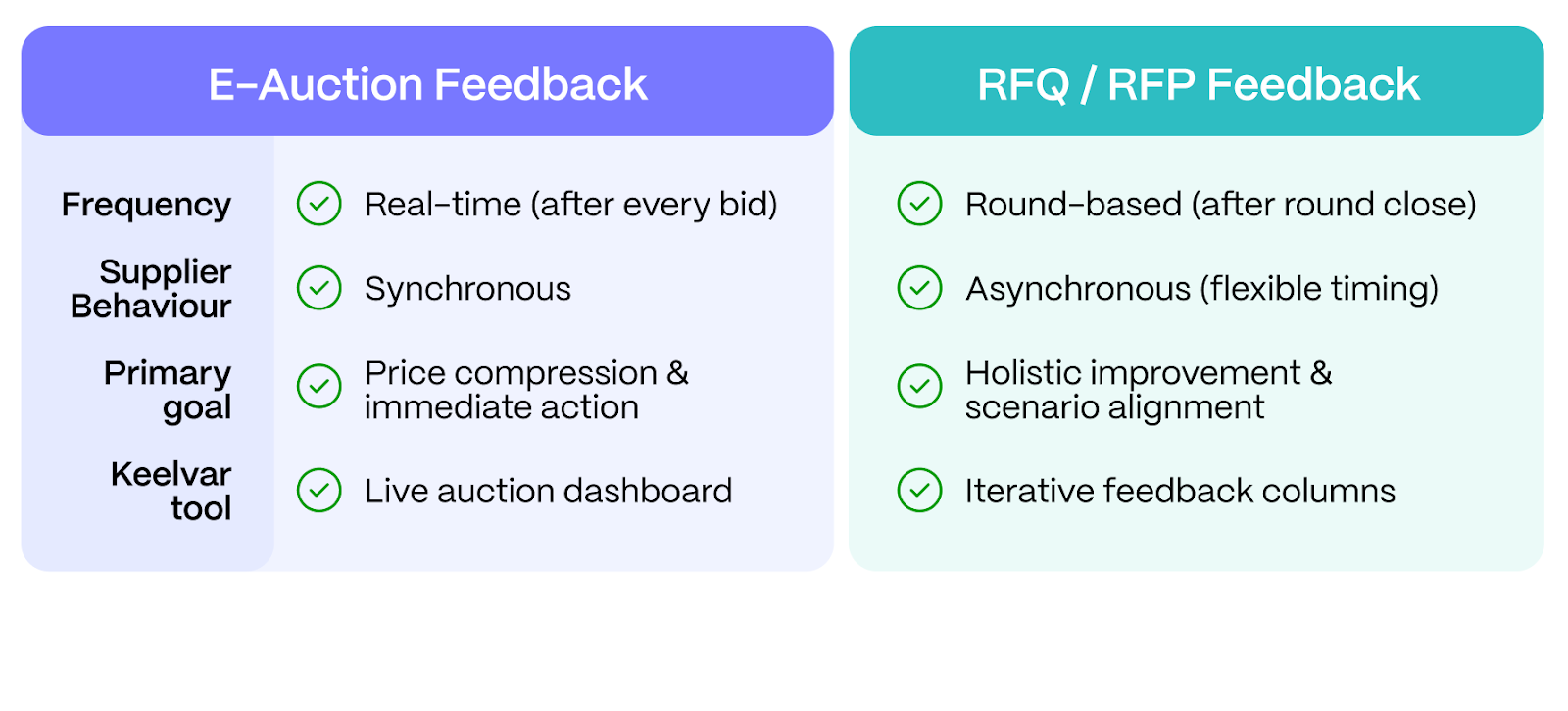
- E-Auction Feedback (The Pulse of Competition): In the high-stakes environment of a live E-Auction, feedback is continuous and real-time. As suppliers are often online simultaneously, Keelvar provides Dynamic feedback i.e. immediate signals—such as Rank, Leading Bid, or Traffic Light indicators—after every individual bid allowing suppliers to adjust instantly to stay competitive.
- RFQ/RFP Feedback (The Road to Optimization): For complex, multi-round RFQs or RFPs, feedback is structured and iterative. Since these events involve intricate bid sheets and may last weeks, Keelvar typically provides feedback at the close of a round. This allows procurement teams to analyze complex scenarios and non-price attributes before signaling to suppliers where they need to improve in the next round.
Where Technology Changes the Game: The Keelvar Feedback Model
Traditional feedback is often manual, subjective, and inconsistent. Keelvar’s Sourcing Optimizer fundamentally changes this by embedding transparency directly into the sourcing workflow. This moves the needle from "opinion" to evidence-based intelligence. The table below provides a deep dive into the technical and operational differences between traditional e-sourcing tools and Keelvar’s AI-native approach to bidder feedback.
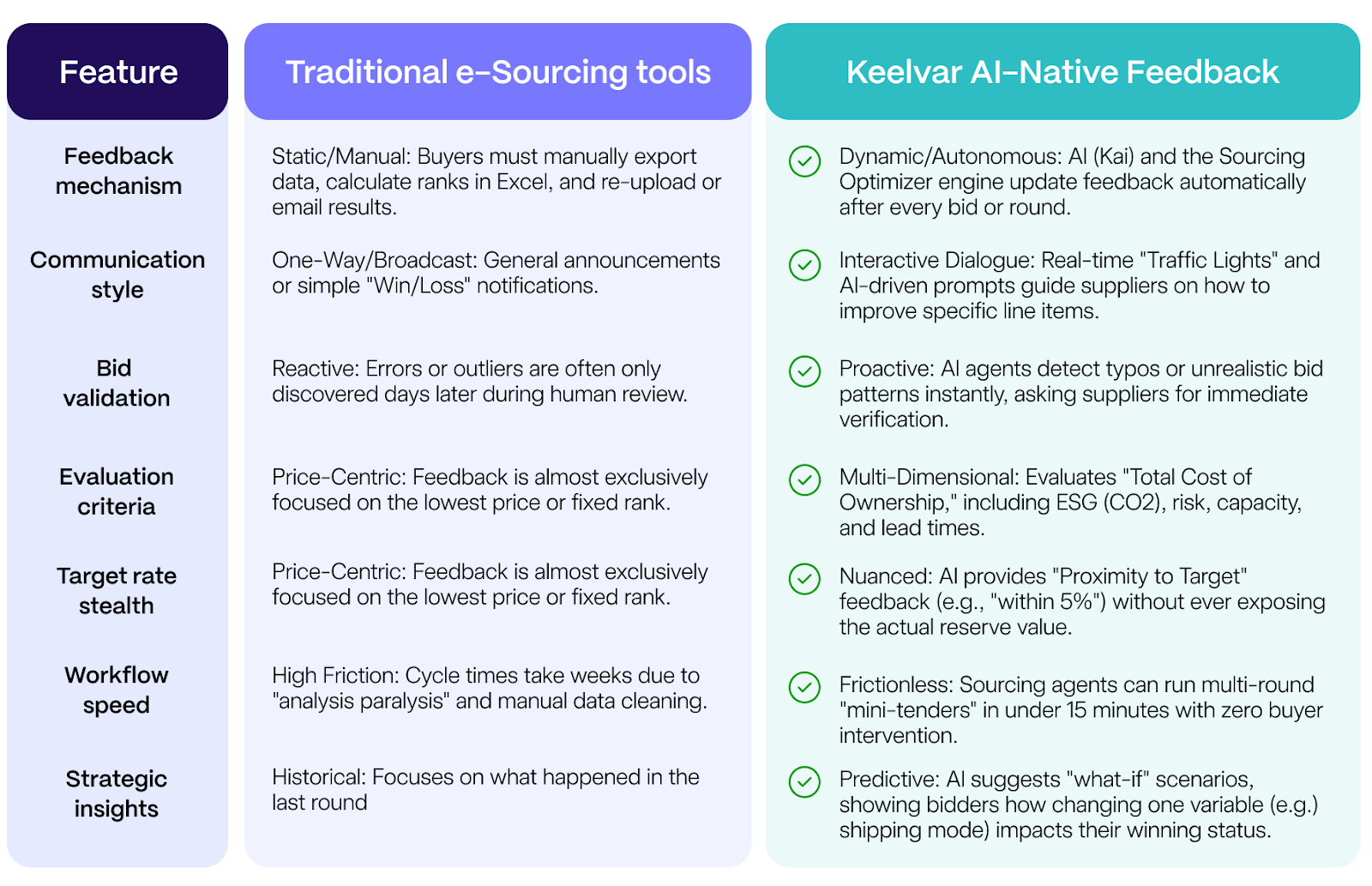
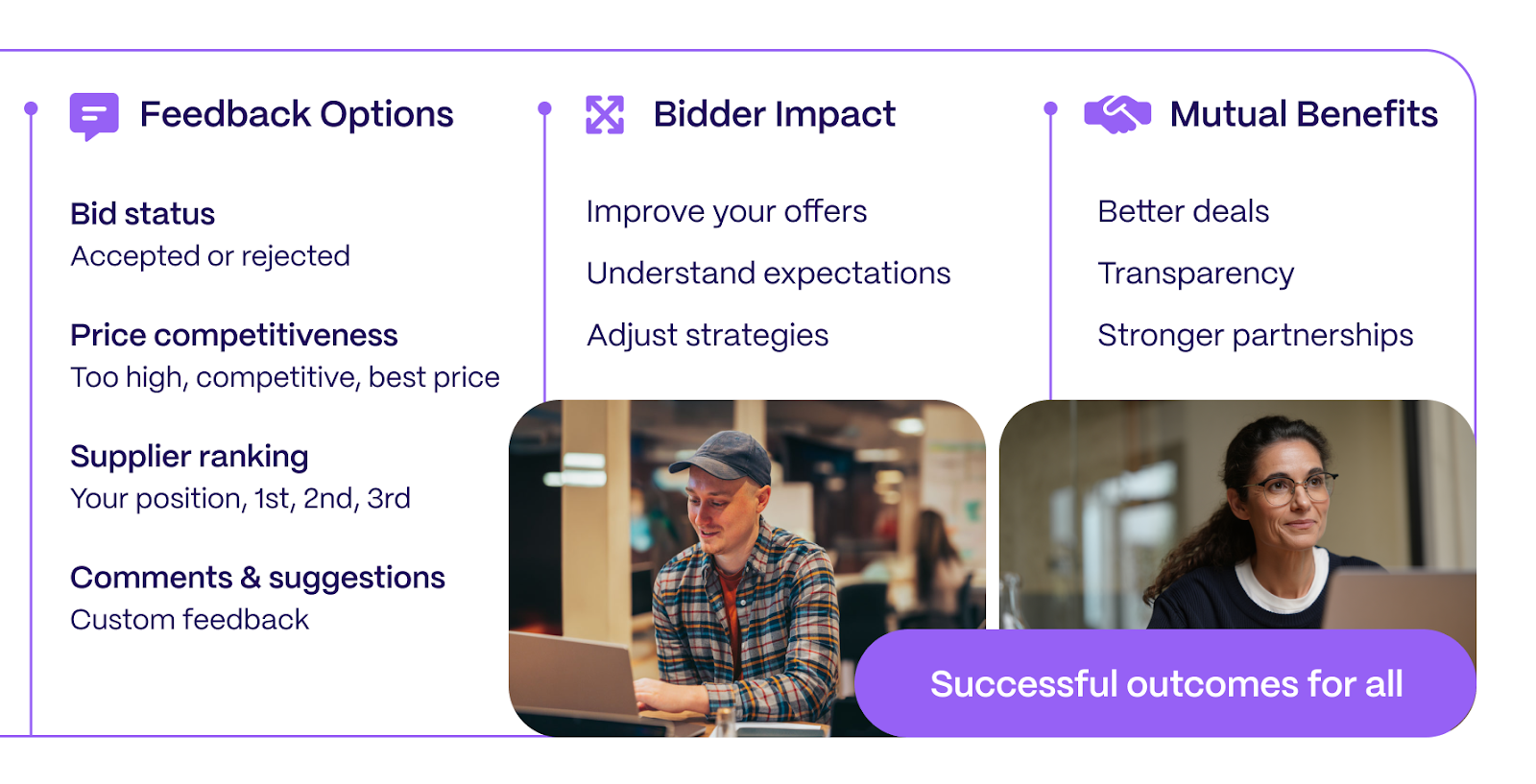
By leveraging Keelvar’s advanced feedback suite, we allow suppliers to react to real-time data signals. Here is how we represent the different feedback options to drive competition and create a Win Win situation for both purchasers and bidders:
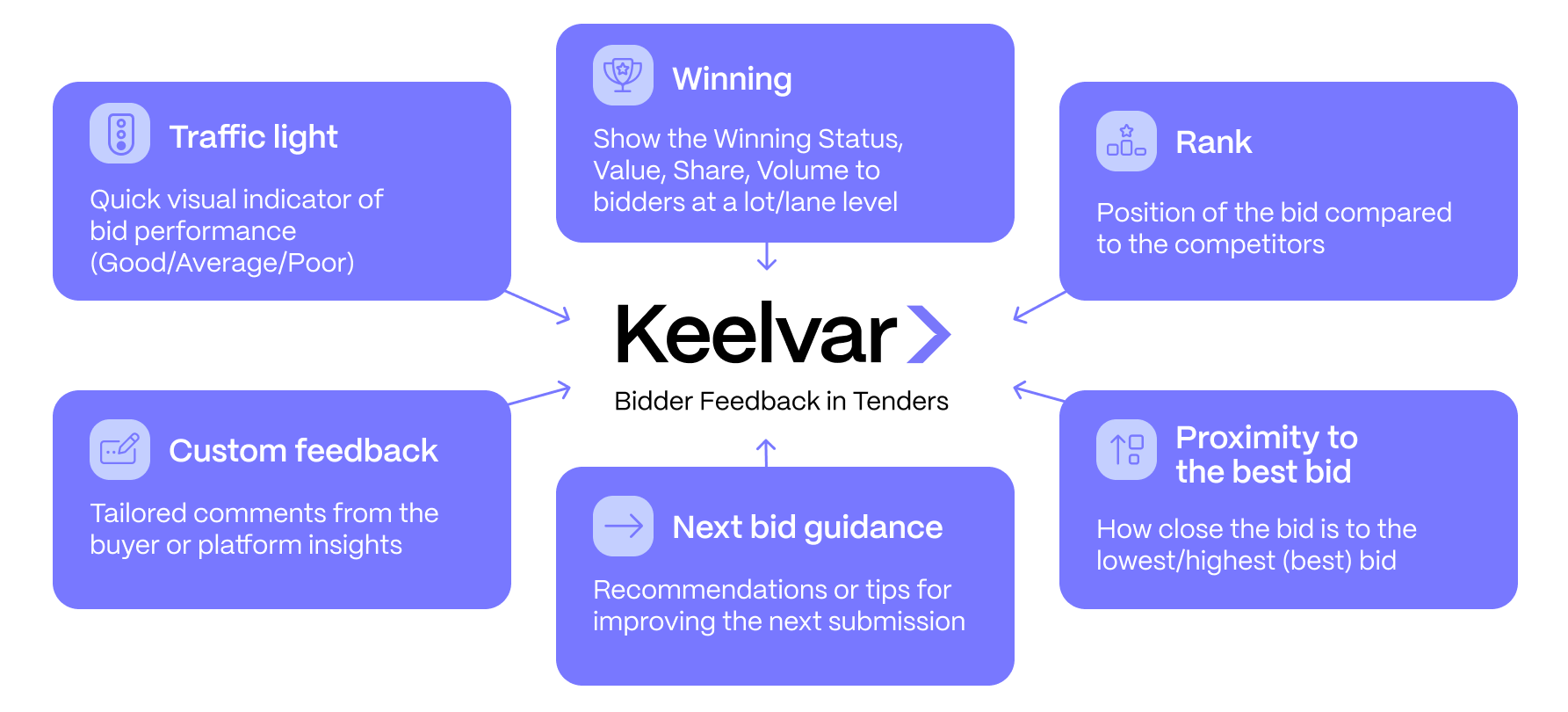
- Traffic Light: Visual cues (Red/Amber/Green) to drive rapid iteration.
- Winning: Shows the Winning Status, Value, Share, and Volume to bidders at a lot/lane level.
- Rank: Clear position of the bid compared to other bidders.
- Proximity: Shows how close a bid is to the best bid—guiding the supplier without revealing the "ceiling."
- Reserve Met: Confirms baseline requirements are satisfied.
- Current/Next Bid: Precise data points that tell a supplier exactly what they need to do to stay in the game.
Custom Feedback: In Keelvar, intelligent custom feedback acts as a real-time "digital coach" that aligns bidder behavior with the purchaser's strategic goals by translating complex bid data into actionable insights. For the purchaser, it automates the negotiation process by instantly flagging non-compliant bids or incentivizing specific outcomes like sustainability; for bidders, it removes the guesswork by providing transparency on their competitiveness without compromising the buyer's sensitive data.
For example, instead of simply seeing a "Rank 2" status, a custom formula can display a "Value Gap" score: by calculating the difference between a bidder's offer and the current "Evaluated Best" (incorporating price, CO2 emissions, and carrier reliability), the bidder might see a message stating, "Your bid is $3.5 \ %$ away from the leading value position; consider reducing your carbon footprint or transit time to bridge the gap." This specific guidance encourages the bidder to refine their proposal in ways that directly benefit the purchaser's total cost of ownership rather than just cutting price.
Real-World Impact: How Bidders Win with Better Feedback
Transparency doesn't just benefit the buyer; it empowers the bidder to be more efficient. Here are three practical examples of how Keelvar’s feedback has optimized outcomes:
1. Logistics: Improving "Lanes of Interest" In a global ocean freight tender, a carrier was initially uncompetitive across 40% of their lanes. Through Keelvar’s Rank and Next Bid feedback, they realized their pricing was misaligned with their backhaul capacity. They adjusted their strategy mid-round, lowering rates on lanes that filled their empty containers. The Result: The buyer saved 12%, and the carrier secured high-utilization lanes.
2. Direct Materials: Rewarding Sustainability A packaging supplier was the low-cost bidder but was losing on "Total Value" due to a high carbon footprint. Through Proximity feedback regarding ESG scores, the supplier offered an alternative recycled material they hadn't initially bid. The Result: The supplier won the contract by pivoting to a higher-value, greener offering that met the buyer's ESG constraints.
3. MRO: Driving Regional Competitiveness A facilities management provider was bidding a national contract but was only "Green" (Traffic Light) in two out of five regions. By seeing their Rank in the underperforming regions, they identified a local subcontracting margin error. They corrected the error in Round 2. The Result: The buyer avoided the headache of managing multiple regional vendors by awarding to a single, now-competitive national provider.
AI, Automation, and the Future of Feedback
The next evolution is already here with the new “Bid Automation” feature that makes it easier for bidders to react to feedback by removing the manual effort and time delay traditionally associated with "re-bidding." Here is how it specifically facilitates the reaction to feedback:
1. Instant Iterative Bidding :In many sourcing events, "feedback" comes in the form of a "Traffic Light" (Red/Yellow/Green) or a ranking. Normally, a bidder would have to see that feedback, calculate a new price, and manually re-submit. Bid Automation automates iterative bidding, meaning the system can intelligently adapt to purchaser feedback and submit a new bid instantly based on the supplier’s pre-defined strategy.
2. Elimination of the "Manual Bottleneck": Bidders often miss out on winning because they cannot react fast enough to feedback before a round closes. Bid Automation provides a competitive edge over manual bidders by responding at "lightning speed." The bidder doesn't have to "lift a finger" to adjust their bid in response to their competitive positioning.
3. Pre-Defined Strategy Alignment: The tool allows suppliers to configure bidding strategies alongside their Rate Cards. This means the bidder decides in advance how they want to react to certain types of feedback. When the feedback is received, the system executes the reaction (the new bid) according to those pre-set rules, ensuring the response is always within the supplier’s preferred margin and logic.
4. Real-Time Optimization via Dashboard: While the bidding is automated, the bidder can monitor how the automation is reacting to feedback through a personalized Bid Automation dashboard. This allows them to see how their strategy is performing in real-time and make high-level adjustments if they aren't winning as expected.
In conclusion, in the complex dance of modern procurement, effective bidder feedback isn't just a nicety; it's a necessity. It’s time to unleash the power of the unseen handshake and empower your bidders to help you achieve your best outcomes. With Keelvar, feedback is no longer manually written or dependent on buyer availability. It is automatically generated, embedded in the workflow, and auditable.
Final "Next Steps" for the Reader:
- Audit Your Feedback Loop: Ask your team how long it currently takes to provide meaningful feedback to unsuccessful bidders and whether that feedback is actionable.
- Pilot Agentic AI: Explore how Kai can automate "Traffic Light" columns in your next high-complexity event to provide real-time guidance to your supply base.
- Humanize the Data: Use AI to handle the "what" and the "where," so your team can focus on the "how" and the "why" during strategic supplier relationships.
- Empower Bidders with Automation: Encourage your suppliers to adopt Bid Automation.
Want to learn more on how to adopt Bidder Feedbacks? Contact us today
As a Principal Consultant at Keelvar, I’ve seen firsthand how intelligent automation transforms procurement. Yet, a persistent hurdle remains: Feedback Friction. While most leaders agree feedback is important, many teams struggle with the "how-to." They are often paralyzed by three core questions:
- What data is safe and effective to share?
- When is the optimal time to reveal it?
- How do you actually configure these rules within a platform?
In today’s volatile market, staying in a "black box" mode doesn't just frustrate suppliers—it actively hurts your outcomes.